
People everywhere think of this month as the “love month”. Sweet gestures like romantic greeting cards, red heart-shaped boxes filled with candy, bouquets of flowers, and dinner at favorite restaurants show up for loved ones all month, especially on Valentine’s Day. Typically those things are seen as expressions of love. Yet I’ve interviewed and talked to so many women who don’t see those things as “love” but obligation, or who will say something like, “it’s better than nothing.” And more than one man has complained to me that his spouse didn’t appreciate the candy or the card and his effort.
I’m not surprised.
What Do Women – and Men – Really Want
While cards, candy, and flowers are nice, once you’re past the early stages of a relationship, they are still seen as “nice” but miss the mark. There’s something more they want, something that fills some empty space. And there is a name for it.
To be honest, though I’ve been talking, teaching, and coaching marriage partnership skills for years, I didn’t know there was a name for the combination of good relationship behaviors. Now I do. They come under the umbrella called Partner Conscientiousness.
So, this month, while the world is focusing on love-in-general, that’s what I want to focus on here. It’s the stuff that makes relationships matter.
More Important Than Token Gifts
So what does Partner Conscientiousness mean?
Partner Conscientiousness means having a romantic partner who is responsible, organized, reliable, and dependable. A conscientious partner shows up physically, mentally, and emotionally. That means s/he communicates openly, keeps commitments, helps manage household tasks, pays the bills on time, shares when it comes to taking care of the stuff of the house, and works jointly to create a stable, supportive home life.
Partner conscientiousness does good things for couples. It helps to build trust, which leads to a feeling of emotional safety, which promotes better physical and mental health and, according to a recent study reported on in the Journal of Sociology, even increases your net worth!
Making It Work
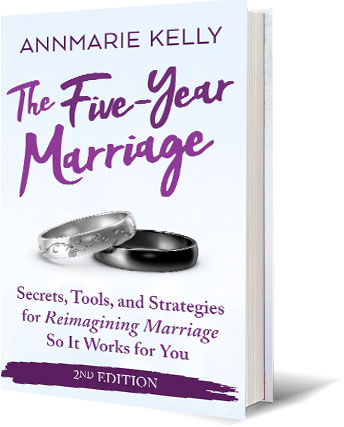
In The Five-Year Marriage, one of the ways – maybe the biggest way – to boost partner conscientiousness is with regular family meetings. It’s a technique Joseph and I first learned from the late Stephen Covey. We adapted the method and started using it at the end of our second marriage, after getting some couples therapy. At first, Joseph wasn’t as excited about doing it as I was. However, after the first month or so, the shift in our partnership was noticeable; Family Meetings were working.
I describe Family Meetings in detail in my book, The Five-Year Marriage 2nd Edition: Secrets, Tools, and Strategies for Reimagining Marriage So it Works For You.
Here’s the short version:
1. Agree to meet regularly. Start with once a week or every other week
2. Meet outside your home (Coffee shops like Starbucks and Panera work well)
3. Have an agenda with the things that need to be talked about or done
4. Start your meeting with “what’s going right?” and then review the “to-do” from last meeting and discuss
5. Work through the stuff on the agenda and divie up the tasks;
6. Write down the things you agree to do in a Family Meeting book or phone file
7. End the meeting by complimenting yourselves for doing it
Want more?
You can get the detailed version of family meetings – and so much more – by ordering your copy of The Five-Year Marriage. Get it here: The Five-Year Marriage